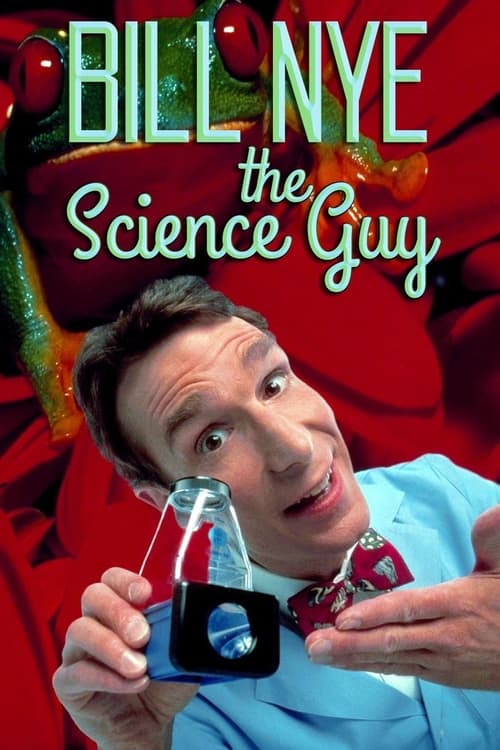
Bill Nye the Science Guy
1993
📺 5 Seasons
🎬 100 Episodes
📅 Ended
🌐 EN
⏱️ 26 min/episode
ComedyDocumentaryKids
It's "Mr. Wizard" for a different decade. Bill Nye is the Science Guy, a host who's hooked on experimenting and explaining. Picking one topic per show (like the human heart or electricity), Nye gets creative with teaching kids and adults alike the nuances of science.
Where to Watch (US)
Buy
 Amazon Video
 Apple TV
 Google Play Movies
 Fandango At Home
Seasons
Season 1
Things that fly need air. Even though we walk through it, breathe it, and sneeze it, air seems to be a whole bunch of nothing. But air is there, and it's powerful. Balloons inflate because air presses on the insides and outsides of the balloon. Air pressure in tires supports the weight of bikes, buses, trucks, cars, and planes. But air doesn't need to be inside something to exert pressure. Air that moves around pushes, too. What do birds, planes, kites, Frisbees, and helicopters have in common? They fly because moving air creates lift, or a push up. Airplane wings are shaped to push air down. The momentum of the air going down pushes wings up. Air above the wing gets going faster than the air underneath. Fast-moving air zips along, without pushing as hard side to side or up and down. The slow air pushes up from below harder than the fast air pushes down from above ... and you're airborne! Every flying thing, from the tiniest flying insect to the biggest airplane, us
Season 2
Magnetic fields; how to make a compass; why opposites attract.
Season 3
Each planet is different. They are all different sizes – Pluto’s the smallest, and Jupiter’s the biggest. They come in a variety of colors – Mars is covered with rust, so it looks red; the methane (cold natural gas) in the atmosphere of Uranus makes it look blue; and Saturn’s colorful rings are made of icy rock. As far as we know now, Earth is the only planet in our solar system that is home to living things.
Season 4
Water is massive; rivers are powerful. As rivers flow downhill, they wear away rock and soil to form canyons or winding curves in the land, called meanders. Sometimes rivers fill and overflow their banks. Rivers with too much water create floods that can carry away plants, trees, buildings and boulders. Rivers and streams support most of the ecosystems on land.
Season 5
Forensic scientists try to find out the who, what, when, where, and why of events in the past – crimes. Most forensic scientists work in police labs. They collect evidence from the scene of a crime and analyze the evidence in a lab. Forensic scientists look for clues that will help them solve a crime. Fingerprints, footprints, hair, blood, and traces of gunpowder can be helpful evidence. Forensic scientists use all sorts of scientific instruments to analyze even the smallest bit of hair or the tiniest chip of paint. By scientifically testing evidence from the crime scene, and by knowing about evidence from past cases, forensic scientists can piece together what happened, to figure out who did what, and to help police catch a criminal.

Crew
Writer
Bill Nye, Michael Gross, Kit Boss
Producer
Erren Gottlieb, Elizabeth Brock, Jamie Hammond
Network
PBS
Production
Rabbit Ears Productions, KCTS Television
Keywords
technologyspaceeducationalscience